Home Blog
Trump and Paul: A Way Forward
Trump and Paul: A Way Forward
by John Dennis
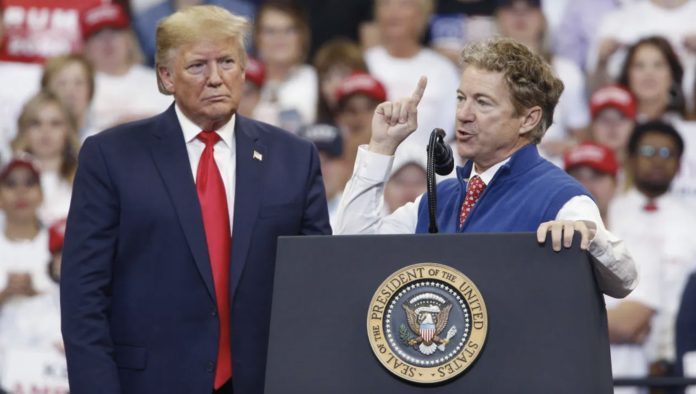
The fundamental distinction between Donald Trump and Rand Paul lies in the primary lens through which each views America’s challenges and priorities. For over four decades, Trump’s political motivation has centered on how foreign countries exploit the United States—economically through unfair trade practices and strategically via inadequate burden-sharing in defense alliances. This outward grievance has driven his consistent push for tariffs, renegotiated agreements, and an “America First” posture that reclaims advantages lost to global partners and rivals.
Trump first articulated this forcefully in September 1987, purchasing full-page ads in The New York Times, The Washington Post, and The Boston Globe. The ads declared: “For decades, Japan and other nations have been taking advantage of the United States,” criticizing allies for not paying enough for U.S. military protection and arguing that America subsidized competitors who then dominated U.S. markets. In 1988 and 1989 interviews, including on Oprah Winfrey’s show and the Morton Downey Jr. Show, Trump accused Japan of “beating the hell out of this country” economically and “systematically suck[ing] the blood out of America” while laughing at U.S. weakness. These complaints persisted through the 1990s and 2010s, expanding to China, Europe, and others “ripping us off.” During his presidencies and into 2025-2026, this has translated into aggressive tariffs—on steel, aluminum, and goods from multiple nations (e.g., 10-145% on various imports)—and demands that NATO allies meet spending targets or face consequences. Trump has framed these actions as ending decades of America being “looted, pillaged, raped and plundered by nations near and far,” withdrawing from international organizations to stop the exploitation.
Rand Paul, by contrast, focuses inward on how Washington exploits Americans through bloated bureaucracy, excessive spending, overreach in surveillance and criminal justice, and wasteful foreign commitments that burden taxpayers. As a libertarian-leaning senator, Paul’s priorities emphasize fiscal restraint, constitutional limits, reducing federal power, and protecting individual liberties at home. While he shares skepticism of endless wars and foreign aid—often holding up or criticizing Ukraine packages for lacking oversight, fueling inflation, and diverting resources from domestic needs like high gas and grocery prices—he frames these as symptoms of Washington’s internal excesses rather than primarily foreign freeloading. His efforts include blocking spending bills, pushing for transparency (e.g., on Fauci-related records), opposing executive overreach in areas like tariffs (which he calls unconstitutional taxes that raise prices for families), and advocating reforms like rescheduling marijuana to ease federal overcriminalization.
This core divergence—Trump’s external focus on confronting foreign exploitation versus Paul’s internal crusade against government overreach—has produced occasional friction. Recent examples include Paul’s criticisms of Trump’s tariffs as an “economic fallacy” that punishes consumers and erodes checks and balances, his introduction of bills requiring congressional approval for tariffs, and his opposition to aspects of Trump’s reconciliation “Big Beautiful Bill” and government funding packages over deficit concerns. On foreign policy, Paul has co-sponsored resolutions limiting unauthorized military actions (e.g., in Venezuela) and held firm against large-scale aid, sometimes aligning with restraint but clashing when Trump’s approach involves aggressive executive posture. Public exchanges have highlighted these tensions, with Trump occasionally accusing Paul of disloyalty and Paul defending his positions as principled constitutionalism.
Yet these priorities are not opposed—they are complementary within the broader America First framework. Trump’s outward-oriented confrontations—tariffs to deter unfair practices, demands for allied contributions, withdrawals from burdensome pacts—strengthen America’s leverage internationally, reducing the economic and strategic drains that Paul decries domestically. Paul’s inward reforms—slashing deficits, enforcing fiscal discipline, curbing bureaucratic excess, and insisting on congressional oversight—ensure that gains from Trump’s external policies aren’t squandered on endless spending, unnecessary entanglements, or big-government growth at home. Together, they address the full spectrum of threats: external actors weakening the U.S. abroad and internal overreach burdening citizens within.
Their working relationship demonstrates this synergy in action. Despite differences, Paul has described agreeing with Trump “far more than we disagree,” highlighting mutual support on non-interventionist instincts, avoiding unnecessary wars, and challenging establishment norms. Post-2024, Paul issued an enthusiastic endorsement in February 2025, admitting he was “wrong” to withhold it earlier, praising Trump’s cabinet picks, Ukraine stance (opposing escalation), and DOGE success—while maintaining honest disagreement on tariffs (“still a terrible idea”). Paul has defended constitutional principles without personal animosity, noting politics has “a bit of WWE in it” but affirming support on most issues. Trump, in his first term, called Paul reliable (“He’s never let me down”), and their interactions reflect a coalition dynamic where libertarian restraint tempers nationalist assertiveness.
In the fractious Republican landscape—spanning nationalists, libertarians, and interventionists—a functional partnership between Trump and Paul advances America First more robustly than either could alone. Trump’s bold external actions create negotiating power and deter exploitation; Paul’s domestic vigilance safeguards resources, enforces accountability, and prevents Washington from undermining victories through profligacy. This balance tempers aggressive policies with fiscal conservatism and constitutional restraint, fostering a stronger, more solvent, freer America.
Consider how reciprocity—the powerful human tendency to return favors—already operates here: Trump’s willingness to champion restraint-oriented policies (e.g., defunding globalist groups, opposing escalation abroad) reciprocates Paul’s principled stands, building goodwill. Liking plays a role too—both men share a mutual respect for bucking orthodoxy, with Paul praising Trump’s boldness and Trump appreciating Paul’s consistency. Social proof emerges in the growing Republican consensus that America First requires both external strength and internal discipline, as seen in widespread party support for their aligned efforts. Authority reinforces the case: Trump’s decades-long track record on trade grievances and Paul’s consistent libertarian advocacy lend credibility to the combined approach. Commitment and consistency drive their collaboration—once committed to America First, both men align actions accordingly, even amid disagreements. Finally, scarcity adds urgency: the window to reclaim U.S. advantages abroad while curbing domestic waste is limited—opportunities like tariff leverage or spending reforms won’t last forever if not seized together.
Their collaboration, built on shared skepticism of globalist overreach and a willingness to challenge norms, offers a model for the party’s future: outward strength paired with inward discipline. By embracing this complementary dynamic, Trump and Paul can deliver lasting prosperity and liberty for Americans first—proving that principled differences, when harnessed ethically, strengthen rather than divide.
John Dennis is the Chairman of the Republican Liberty Caucus. John has been an RLC member since 2010 and he has served on the RLC National Board since 2015.
RLC Publishes 2026 Liberty Index: Massie Stands Alone at the Top
January 29, 2026
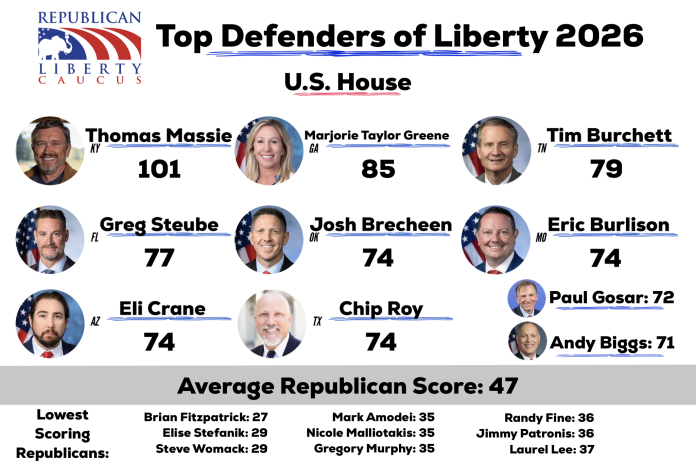
The Republican Liberty Caucus (RLC) has published its 2026 Liberty Index, its annual scorecard evaluating U.S. House Republicans on votes from 2025. Once again, Rep. Thomas Massie earned the highest score, emerging as a consistent champion of liberty amid widespread disappointment.
The Liberty Index scores Republican members of Congress on 20 key votes that either advanced or undermined core RLC principles: individual liberty, limited government, free markets, fiscal responsibility, and an America First, non-interventionist foreign policy. This year’s results were grim for most House Republicans. With full GOP control of the House, Senate, and White House in 2025, the party had a golden opportunity to deliver on long-standing promises of fiscal restraint. Instead, most members rubber-stamped spending bills that perpetuated Biden-era levels, further inflating the national debt—now exceeding $38 trillion.
While Republicans notched a few wins—such as the passage of H.J. Res. 20, H.J. Res. 35, and H.J. Res. 87, which repealed unnecessary EPA and Department of Energy regulations—these modest free market victories pale against the backdrop of trillions in continued spending.
As for the scoring, the Liberty Score is obtained by calculating the percentage that a Representative votes in line with the RLC. For example, the highest possible Liberty Score is 100. This is achieved if they voted with the RLC 100% of the time. Bonus points are awarded for cosponsoring certain bills that never received a floor vote. After factoring in the bonus points, it is possible for some Representatives to score above 100.
The 2026 Liberty Index delivers a clear message: House Republicans largely abandoned fiscal conservatism when it mattered most. Scores plummeted for many who had campaigned as budget hawks.
Most Republicans in Congress won’t be happy with their score on the 2026 Liberty Index, but the RLC isn’t here to make friends in Washington. We’re here to keep our politicians accountable for their actions.
True liberty demands more than occasional victories; it requires consistent courage against the status quo, as Massie demonstrates. Congressman Thomas Massie stood out as one of the few willing to vote no on reckless, wasteful appropriations. His near-perfect record cements himself as Congress’s most principled defender of liberty.
View the full 2026 Liberty Index scorecard below or on Scribd.
The Republican Liberty Caucus Endorses Paul Rojas in TX CD-21
FOR IMMEDIATE RELEASE
January 20, 2026
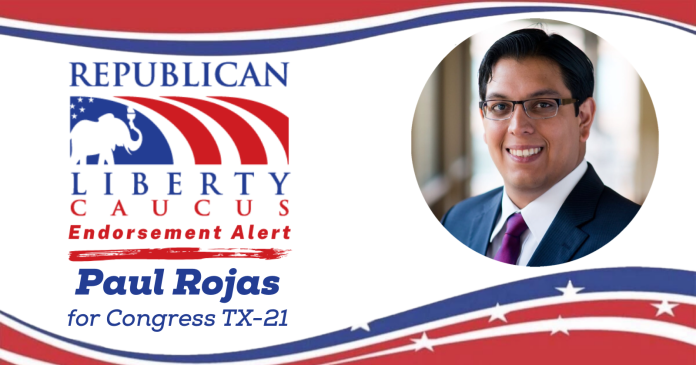
The Republican Liberty Caucus Endorses Paul Rojas for Texas’ 21st Congressional District
SAN ANTONIO – The Republican Liberty Caucus (RLC) has officially endorsed Paul Rojas in the race for Texas’ 21st Congressional District, citing his unwavering commitment to constitutional governance, America First principles, and the values of the Texas Hill Country.
“Paul Rojas is the only candidate running for TX CD-21 who possesses the dedication to fundamental Constitutional values and the drive to carry forward Chip Roy’s America First legacy,” said RLC Chairman John Dennis.
Paul Rojas understands that liberty begins with limiting government, defending individual rights, and putting the people of the Hill Country first — not Washington insiders or outside special interests.
Rojas stressed that his campaign is rooted in a simple but urgent principle: the Hill Country comes first.
“For too long, the communities of TX-21 have been treated as an afterthought by Washington,” Rojas said. “Our families, our jobs, our land, our water, and our freedoms must come before foreign aid packages, bloated bureaucracy, and political theater. I’m running to ensure the Hill Country always has a voice that puts Texas first.”
A lifelong Texan, Rojas brings a unique blend of technical expertise, business experience, and constitutional conviction to the race. He holds a Bachelor of Science in Physics, a Master’s degree in Software Engineering, and a Master’s degree in Technology Commercialization, equipping him with firsthand knowledge of the challenges facing American innovation, infrastructure, energy, and national security.
In addition, Rojas is a firearms manufacturer and small business owner, giving him direct experience with the regulatory burdens, economic pressures, and federal overreach that threaten American manufacturing and the Second Amendment.
“The Republican Liberty Caucus endorsement represents the grassroots — not the establishment,” Rojas added. “I’m committed to defending the Constitution, protecting American jobs, and continuing the America First legacy that TX-21 voters expect and deserve.”
The endorsement further solidifies Rojas’ standing as the leading pro-liberty, pro-Constitution, America First candidate in the TX-21 congressional race.
For more information, visit www.rojas4texas.com.
About the Republican Liberty Caucus: The Republican Liberty Caucus is a 527 voluntary grassroots membership organization dedicated to working within the Republican Party to advance the principles of individual rights, limited government and free markets. Founded in 1991, it is the oldest continuously-operating organization within the Liberty Republican movement.
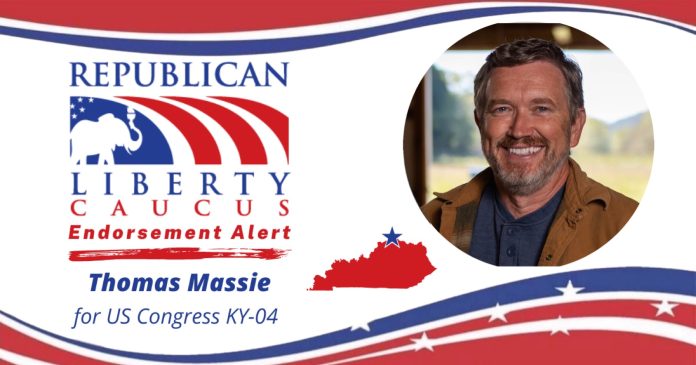
The Republican Liberty Caucus Proudly Endorses Thomas Massie
FOR IMMEDIATE RELEASE
December 17, 2025
The Republican Liberty Caucus Proudly Endorses Congressman Thomas Massie in Kentucky’s 4th Congressional District
As many Republicans in Congress abandon their campaign promises to go along with the D.C. swamp, Congressman Thomas Massie is one of the few still fighting for liberty.
“Congressman Massie has consistently embodied the principled constitutional conservatism that the Republican Liberty Caucus stands for,” said RLC Chairman John Dennis. “His unwavering commitment to limited government, fiscal responsibility, and individual liberty is exactly what the Republican Party needs.”
Massie is the only U.S. Representative with a perfect lifetime score of 100 on the RLC’s Liberty Index scorecard. His voting record reads like a checklist of RLC principles:
Limited Government: Massie consistently opposes bloated spending bills that add to our $38 trillion national debt, regardless of which party proposes them. He is one of the few in Congress willing to push back against bipartisan fiscal recklessness.
Individual Rights: A fierce defender of the Bill of Rights, Massie has championed legislation protecting Second Amendment rights, Fourth Amendment privacy protections, and the constitutional limits on federal power.
Free Markets: Massie consistently votes against legislation that increases burdensome regulations on private businesses.
America First Foreign Policy: Massie has been an unapologetic voice for a constitutional, America First foreign policy of peace and non-interventionism.
Government Transparency: Massie recently led the bipartisan effort demanding the release of the Jeffrey Epstein files, demonstrating that accountability should apply to the powerful regardless of political affiliation.
The corrupt establishment is coming after Congressman Massie because he is the most honest and principled person in Congress. That’s exactly why we must do everything possible to support him.
Send the swamp a message: We want liberty. We want a smaller, constitutional government. We want Thomas Massie reelected.
Donate to Congressman Thomas Massie’s campaign
About the Republican Liberty Caucus: The Republican Liberty Caucus is a 527 voluntary grassroots membership organization dedicated to working within the Republican Party to advance the principles of individual rights, limited government and free markets. Founded in 1991, it is the oldest continuously-operating organization within the Liberty Republican movement.
2025 Republican Liberty Caucus Convention Recap
Dear RLC Members and Supporters,
Your engagement, your energy, and your commitment to defending liberty made this one of the strongest gatherings in our organization’s history. Congratulations to all of our newly elected officers who will help lead the Republican Liberty Caucus into the crucial battles ahead.
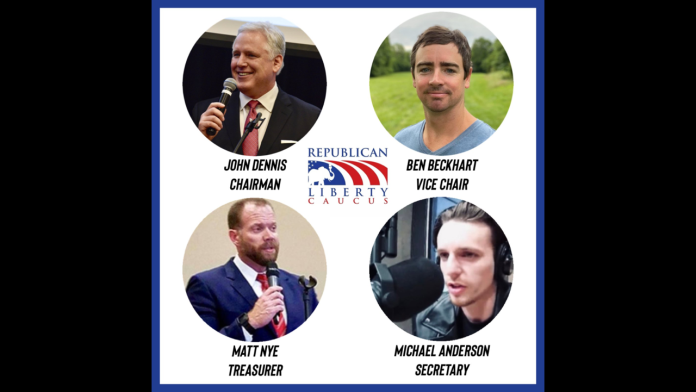
 National Officers
Chairman: John Dennis (@RealJohnDennis)
Vice Chair: Ben Beckhart (@Ben_Beckhart)
Treasurer: Matthew Nye (@matthewdnye)
Secretary: Michael Anderson (@HarviiLee)
Regional Directors
Atlantic: Dr. Irene Mavrakakis (@IreneMavrakakis)
South East: Sharon Regan
Great Plains: Mike Franco
South Central: Jeff Hutt
South West: Bill Brown (@billbrown)
At-Large Board Members
Russ Hryzan
James Peinado (@wstxag08)
Bob Sutton
We also extend our gratitude to the tremendous speakers who joined us, including Rep. Thomas Massie, Rep. Warren Davidson, and Senator Rand Paul — champions of constitutional liberty whose leadership continues to inspire our movement.
Throughout the convention, attendees heard powerful discussions on spending restraint, decentralization, free markets, constitutional carry, civil liberties, and restoring limits on federal power.
From the fight to repeal the PREP Act and end federal propaganda, to expanding the PRIME Act, auditing and ultimately ending the Federal Reserve, repealing the Department of Education, strengthening War Powers authority, and pushing for the national vote on releasing the Epstein files — the message was clear:
We will keep fighting for liberty with conviction, transparency, and courage.
This year’s convention reaffirmed that the Republican Liberty Caucus is growing, energizing the grassroots, and positioning itself to be a principled force within the broader Republican Party.
As the political landscape continues to shift, the RLC will stand firm for the values that built this movement: limited government, individual rights, free markets, and constitutional governance.
Thank you again for your dedication. Together, we will make 2025 a defining year for liberty.
In Liberty,
John Dennis
Chairman, Republican Liberty Caucus
RLC Statement on June 21st Iran Strikes
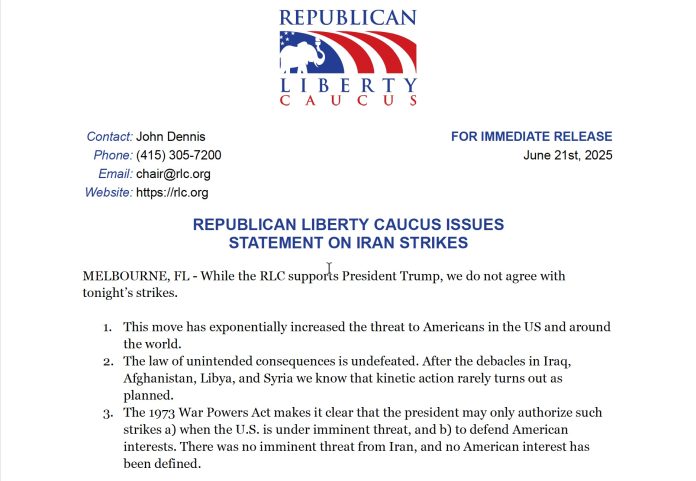
MELBOURNE, FL – While the RLC supports President Trump, we do not agree with tonight’s strikes.
- This move has exponentially increased the threat to Americans in the US and around the world.
- The law of unintended consequences is undefeated. After the debacles in Iraq, Afghanistan, Libya, and Syria we know that kinetic action rarely turns out as planned.
- The 1973 War Powers Act makes it clear that the president may only authorize such strikes a) when the U.S. is under imminent threat, and b) to defend American interests. There was no imminent threat from Iran, and no American interest has been defined.
Under any other circumstance the Constitution is clear that the war power resides with Congress.
The American people elected President Trump, in part, because his antiwar disposition and master negotiating skills offered the prospect of a peaceful and prosperous America.
Tonight’s bombing of Iran contradicts President Trump’s peace instinct, and we hope the opportunity remains for him to employ his negotiating skills toward a resolution without further military engagement.
About the Republican Liberty Caucus
The Republican Liberty Caucus is a 527 voluntary grassroots membership organization dedicated to working within the Republican Party to advance the principles of individual rights, limited government, and free markets. Founded in 1991, it is the oldest continuously operating organization within the Liberty Republican movement.
Libertarian Party 2024 Vice-Presidential Nominee Mike ter Maat Joins Republican Liberty Caucus
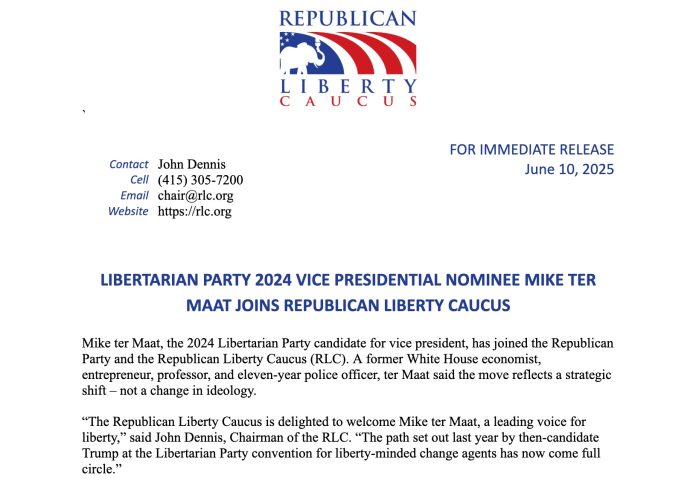
Mike ter Maat, the 2024 Libertarian Party candidate for vice president, has joined the Republican Party and the Republican Liberty Caucus (RLC). A former White House economist, entrepreneur, professor, and eleven-year police officer, ter Maat said the move reflects a strategic shift – not a change in ideology.
“The Republican Liberty Caucus is delighted to welcome Mike ter Maat, a leading voice for liberty,” said John Dennis, Chairman of the RLC. “The path set out last year by then-candidate Trump at the Libertarian Party convention for liberty-minded change agents has now come full circle.”
“The Republican Party will be the arena for the critical debate of the next political cycle,” added ter Maat. “To strengthen our economy through free markets, unify our nation through the Constitution, and protect our future through fiscal conservatism and a common-sense foreign policy, we must engage where it matters most.”
Alongside ter Maat, forty-one liberty advocates are joining the RLC, many of whom played roles in ter Maat’s 2024 campaign, some transitioning from the LP, others are already members of the GOP. Several will take on active roles expanding the RLC’s reach ahead of the 2026 midterm elections and the 2028 presidential cycle.
Dennis said, “The Republican Liberty Caucus is the right entry point for liberty Republicans, Libertarians, and independents committed to the fight for liberty and constitutional governance. The RLC is excited to fulfill this important role.”
This new recruitment effort is spearheaded by four leaders in the Libertarian Party:
• Michael Smith, 2024 ter Maat campaign advisory chairman and former chair of LP-Broward, Florida,
• Irene Mavrakakis, 2024 ter Maat campaign outreach director, former chair of LP-Delaware and founder of Liberty Speaks,
• David Moscrip, former chair of LP-Hillsborough, Florida, who is returning to the GOP in which he had been a long-time organizer in Indiana, and
• Corey Fauconier, former communications director & state senate candidate, LP-Virginia and host of Talks Over Drinks podcast.
Concluded ter Maat, “This is the right team, supporting the right brand, to fight the right fight. We’re excited to join the battle inside the GOP for constitutional governance.”
Other notable individuals making the move include the following:
• Sally Bacon, 2024 ter Maat presidential campaign organizer
• Landon Cahow, 2024 ter Maat campaign & 2006 Carl Whitaker campaign web manager, and member of the Ron Paul 2008 & 2012 campaigns
• DL Cummings, former chairman of LP-Duvall County, Florida, and host of the LibertyDad podcast
• Hailey Dollar, 2026 candidate, Virginia House of Delegates
• Amity Dolby, former District 5 chair, LP-Virginia
• Bill Dunn, Rancher on the Arizona border
• Donna Johnson Grebas, former LP-Virginia District 4 chair, retired US Army Reserve officer
• Joshua Hlavka, former LP-Florida chair and 2024 ter Maat campaign advisor
• Jeff Kleb, Army Reserve veteran, co-host of Talks Over Drinks podcast, Virginia
• Shawn Lux, former LP-Broward County, Florida, secretary
• Jon Marietta, elected Recorder of Deeds, Fayette County, PA and host of the Hillbilly Jon Show on WMBS Radio
• Andrew McClelland, law enforcement sergeant, Florida, and 2020 ter Maat Congressional campaign advisor
• Amy Misko, former LP-Mississippi secretary and founder of Libertarians for Learning
• Evan Murphy, award-winning Manhattan photographer and 2024 ter Maat campaign social media manager
• Brandon Padget, professor of history, Illinois, and 2024 ter Maat campaign organizer
• Russ Paige, intellectual property attorney, Texas, and 2024 ter Maat campaign advisor
• Valentin Potra, 2024 ter Maat campaign worker, linguistic anthropologist, and former professor and senior instructional designer
• David Roberson, former LP candidate for Texas Supreme Court and Texas House, former LP-Texas Committeeman, and 2024 ter Maat campaign worker
• Steve Roberts, former member and 2026 candidate for the Kansas State Board of Education
• Jeffrey Rose. MAHA PAC and MAHA Institute organizer, legislative coordinator for Start School Later
• Sandy Sanders, co-host of Talks Over Drinks podcast, Attorney and Former Contributor Virginia Right
• Sean Shepard, former Congressional candidate, former assistant state director for Americans for Fair Taxation, and Indiana Property Tax Protests organizer
• Donald E. Scoggins, Virginia community activist, Vietnam War veteran, and past candidate for mayor of Baltimore
• Scott Sheldon, entrepreneur & international investment banker and 2024 ter Maat campaign advisor
• Jodi Smith, former president of Indiana Federation of Republican Women, former Susan B Anthony state director, and past recipient of the Sagamore of the Wabash award
• Wendi Szabo, former LP candidate for Royaltown, New York, Town Council, acting chair LP-Niagara County, and 2024 ter Maat campaign affiliate liaison director
• Charlie Tilton, Texas high school teacher and retired Green Beret
• Eric Waterman, former chief of staff at Valley Medical Center in Seattle and 2024 ter Maat campaign advisor
• Mike Webb, 2025 candidate for Arlington Virginia School Board & US Army Ranger Major (retired)
ABOUT THE REPUBLICAN LIBERTY CAUCUS
The RLC is a grassroots organization working within the Republican Party to advance the principles of individual liberty, limited government, and free markets.
ABOUT MIKE TER MAAT
The Libertarian Party nominee for VP in 2024, Mike ran for Congress (FL-20) in 2022 and served as a police officer from 2010 through 2021 in Broward County. Mike’s prior career in economics included work with commercial banks, the White House, and international agencies, as well as a decade advocating for competitive financial service markets before running his professional education and consulting firm from 2002 to 2009. Mike holds a BS in Aeronautical Engineering and an MBA from RPI, and MS and PhD degrees in Economics from GWU. He has taught economics at three universities and substituted at dozens of public schools.
MEDIA INQUIRIES AND INTERVIEW REQUESTS
Corey Fauconier
corey@miketermaat.com
(973) 901-6481
miketermaat.com
John Dennis
chair@rlc.org
The 2024 Senate Liberty Index: Champions of Liberty in Congress
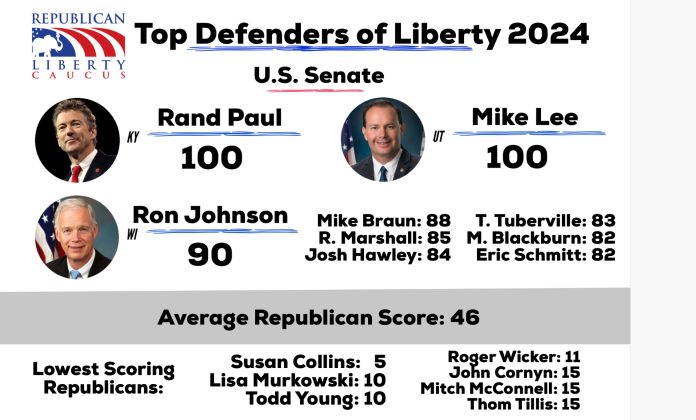
The recently released 2024 Liberty Index reveals a striking contrast within the Republican Party. While Senators Rand Paul (KY) and Mike Lee (UT) achieved perfect 100% liberty scores for consistently voting to protect individual rights and limit government overreach, the average Republican Senator scored just 46%.
These numbers tell a powerful story: the principles that should define the Republican Party are being upheld by a dedicated few, while many establishment Republicans continue supporting bloated government spending, warrantless surveillance, and foreign interventionism.
The complete 2024 Senate Liberty Index, including detailed vote breakdowns and methodology, is available at Liberty Index 2024 – US Senate.
This is precisely why the Republican Liberty Caucus exists – to bring the GOP back to its foundational values.
The 2024 Liberty Index: A Revealing Look at Congress’s Liberty Champions and Pretenders
The Republican Liberty Caucus has released its 2024 Liberty Index, providing a comprehensive analysis of how Republican members of Congress voted on crucial liberty issues throughout the year. The results paint a stark picture of the divide between true liberty advocates and those who merely pay lip service to limited government principles.
The Liberty Index examined 20 pivotal votes affecting individual rights, limited government, and free markets. From government spending and surveillance to foreign intervention and free speech, these votes represented key moments where Representatives could either stand for liberty or embrace big government.
Key Findings:
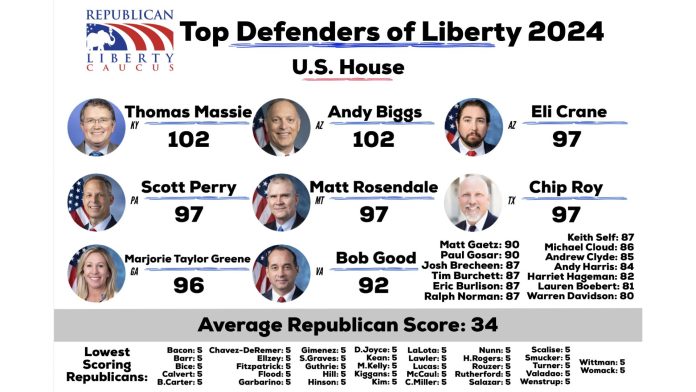
The average Republican score was a disappointing 34 out of 100, revealing that most GOP members routinely vote against liberty principles despite their campaign rhetoric. However, a small group of Representatives consistently defended liberty, with Kentucky’s Thomas Massie and Arizona’s Andy Biggs leading the pack at 102 points each (including bonus points for sponsoring pro-liberty legislation).
Top Performers:
Thomas Massie (KY) – 102
Andy Biggs (AZ) – 102
Eli Crane (AZ) – 97
Scott Perry (PA) – 97
Matt Rosendale (MT) – 97
Chip Roy (TX) – 97
Marjorie Taylor Greene (GA) – 96
Bob Good (VA) – 92
The Index revealed particularly concerning voting patterns on fiscal issues. Multiple continuing resolutions and omnibus spending bills passed with significant Republican support, despite adding to our $36 trillion national debt. Additionally, Republicans frequently sided with leadership on bills expanding government surveillance powers and sending billions in foreign aid abroad.
Critical votes analyzed included:
What’s particularly notable about the top performers is their consistency across different types of liberty issues. Whether the vote involved spending, privacy, foreign policy, or regulatory matters, these Representatives maintained their commitment to constitutional principles.
The Liberty Index serves as an essential tool for holding Representatives accountable to their promises of supporting limited government and individual rights. It cuts through campaign rhetoric to show exactly how members voted when it mattered most.
Looking ahead to 2025, the RLC will continue monitoring these crucial votes and providing transparency about which Representatives truly stand for liberty. The complete Liberty Index, including detailed vote breakdowns and methodology, is available at Liberty Index 2024 – US House.
For liberty advocates and constituents looking to hold their Representatives accountable, this index provides clear, actionable data about who genuinely fights for limited government principles and who simply talks about them during campaign season.
